What Is Enamelware? A Buyer's Guide for Restaurants and Gift Shops
You've seen it everywhere lately — on café counters, in farmhouse kitchens, across the Instagram feeds of every aesthetically-minded restaurant that opened in the last five years. That slightly matte, rimmed, unmistakably vintage-feeling tableware that somehow looks at home in a Michelin-starred gastropub and a muddy festival field at the same time.
That's enamelware. And if you're a restaurant owner, gift shop buyer or hospitality business thinking about branded products, understanding what it actually is — and what it isn't — could save you from an expensive mistake, or point you towards the best branding decision you make this year.
By the end of this guide you'll know exactly what enamelware is made of, why it's become the material of choice for brands who care about how they look, and how to order it with your logo — starting from a single piece.
So what actually is enamelware?
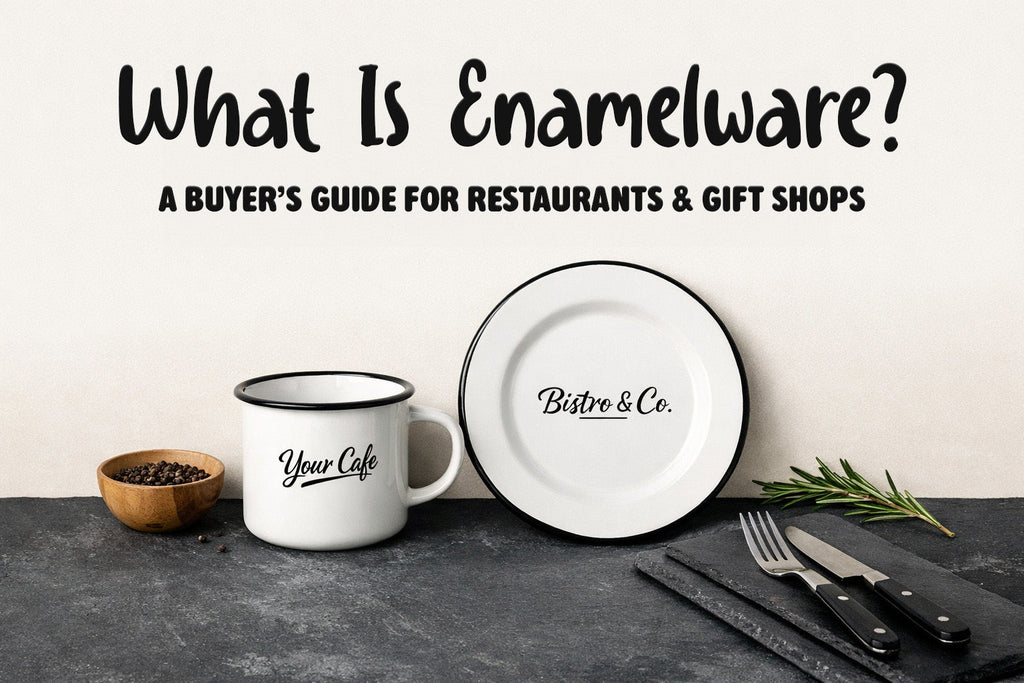
Enamelware is metal — typically steel — coated with a layer of powdered glass that's fired at extremely high temperatures until it fuses to the surface. The result is a hard, smooth, glass-like finish that is simultaneously tough enough to survive a commercial kitchen and refined enough to sit on a beautifully laid table.
It's not new. Enamelware has been produced since the mid-1800s and was a staple of military mess kits, camping equipment and working-class kitchens for over a century. The rimmed edge — that distinctive dark border you see on most enamel mugs and plates — is where the coating meets the raw metal, and it's become one of the most recognisable design details in modern hospitality.
What's new is the context. Enamelware fell out of favour with the rise of cheap plastic and ceramic in the mid-20th century. It's back now — and it's back for good reasons.
Why has enamelware become so popular with restaurants and gift shops?
Several things happened at once.
The rise of the heritage aesthetic in hospitality — think reclaimed wood, exposed brick, hand-written menus — created a demand for tableware that felt considered and characterful rather than generic. Enamelware fits that world perfectly. It looks like it has a history, even when it's brand new.
At the same time, social media changed what tableware needed to do. A white ceramic plate is invisible in a photograph. An enamel plate with a dark rim and a clean logo mark is a prop, a brand signal and a piece of visual content all at once. Restaurants started to understand that the table was part of the brand — and enamelware gave them something worth photographing.
For gift shops, the appeal is slightly different. Enamelware sits in a sweet spot between everyday usefulness and genuine giftability. A branded enamel mug isn't a novelty item that ends up in a drawer — it's something people actually use, display and keep. That makes it one of the strongest retail products a gift shop can stock.
What are the practical advantages for a commercial setting?
Beyond the aesthetics, enamelware earns its place in a working environment.
It's exceptionally durable. The steel core means enamelware can withstand the kind of daily punishment that would chip or crack standard ceramic within weeks. In a busy café or restaurant, that matters considerably to your bottom line.
It's dishwasher safe. Commercial dishwashers are brutal on tableware. Enamelware handles repeated high-temperature cycles without degrading, fading or losing its finish — provided it's genuine quality enamelware and not a cheap imitation with a thin coating.
It's lightweight. Compared to ceramic or stoneware of a similar size, enamelware is noticeably lighter. For staff carrying multiple covers, that adds up over a long service.
It works indoors and outdoors. This is something ceramic simply can't claim. Enamelware is at home on a terrace, at a market stall, on a festival site or in a formal dining room. If your venue has an outdoor element, enamelware is one of the few premium tableware options that genuinely works in both settings.
It photographs differently to everything else. This isn't a small thing. In an era where your customers are your marketing team, tableware that looks distinctive in a photo is tableware that works for you long after the cover is done.
What are the limitations?
Enamelware is honest about what it is — and that means it has a few characteristics worth knowing before you order.
The coating can chip if dropped or subjected to a sharp impact. This is normal and expected — it's the nature of the material, not a quality defect. For most commercial settings it's a non-issue, but it's worth knowing that enamelware is not indestructible.
It conducts heat. An enamel mug filled with hot coffee will be hot to hold — more so than a ceramic mug with thicker walls. Some venues add a silicone band or handle wrap; others lean into it as part of the product's character.
It is not microwave safe. The metal core means enamelware cannot go in a microwave. For most restaurant and café settings this is irrelevant, but for gift retail it's worth communicating clearly on packaging.
What can be customised on enamelware?
Almost everything. The most common customisation options are:
Printed branding — your logo, artwork, wordmark or a phrase applied directly to the surface of the piece. This is the most popular option for restaurants, cafés and corporate gifting, and produces clean, sharp results that hold up to commercial use.
Colour — enamelware is available in a wide range of base colours beyond the classic white. Matte black, olive green, navy, cream and deep red are among the most popular for branded hospitality use. Choosing a colour that aligns with your brand palette is one of the most effective things you can do to make your tableware feel intentional.
The rim — the classic dark rim is standard, but the rim colour can often be customised to match or contrast your brand palette for a more distinctive look.
Copy and phrases — as Burger & Lobster demonstrated with their World Lobster Day plates, enamelware doesn't have to carry a logo. A short phrase, a tagline, a seasonal message — anything that fits the surface can become part of the product.
How do you order custom branded enamelware?
This used to be the part where the answer was: find a large manufacturer, agree to a minimum order of 500 units, wait six weeks, hope it looks right.
That's no longer the case.
At NorthestAve, you can order custom branded enamelware starting from a single piece — directly from our website using our online customisation tool, or by getting in touch for a trade quote if you're ordering for wholesale or want to discuss a specific brief.
There is no minimum order. An independent gift shop wanting to test twelve branded mugs gets the same quality and service as a restaurant group ordering five hundred plates.
How we can help
At NorthestAve we supply custom branded enamelware — mugs, plates, bowls and an expanding range of slate products — to restaurants, cafés, gift shops, event venues and hospitality businesses across the UK and internationally.
What we offer:
- Custom printed enamel mugs, plates and bowls
- Branded slate boards and serving pieces
- No minimum order quantity — order one piece or one thousand
- UK-based with fast turnaround and international shipping
- Trade accounts available for wholesale buyers
Ready to get started?
👉 Browse and customise products directly → (order online with our customisation tool)
For wholesale quotes, bulk orders or just a conversation about what you need:
📞 +44 7356 091993 — call, WhatsApp or SMS, 24/7 📧 sales@northestave.co.uk
No minimum orders. No waiting around. Just drop us a message and we'll get back to you.