Enamelware vs Ceramic vs Slate — Which Is Right for Your Brand?
Walk into ten independently owned restaurants or gift shops this week and you'll find ten different answers to the same unspoken question: what should our products actually be made of?
Most owners never consciously ask it. They inherit a set of plates from a previous tenant, order whatever their supplier has in stock, or default to white ceramic because that's what restaurants use. And then they wonder why their tables look like everyone else's.
Material is a brand decision. It communicates something before a single word is read, before the food arrives, before the customer has even decided whether they like the place. Get it right and everything feels intentional. Get it wrong and even a beautifully designed logo can't save it.
We work with restaurants, cafés, gift shops and hospitality businesses every day — and the question we get asked more than almost any other is: enamelware, ceramic or slate — what's actually best? The honest answer is that it depends entirely on your brand. So here's how to work it out.
Enamelware — for brands with personality and presence
Enamelware is steel coated with a fired glass finish. It's been around since the 1800s, fell out of fashion, and came back with a vengeance — because it does something no other material quite manages. It looks like it has a story.
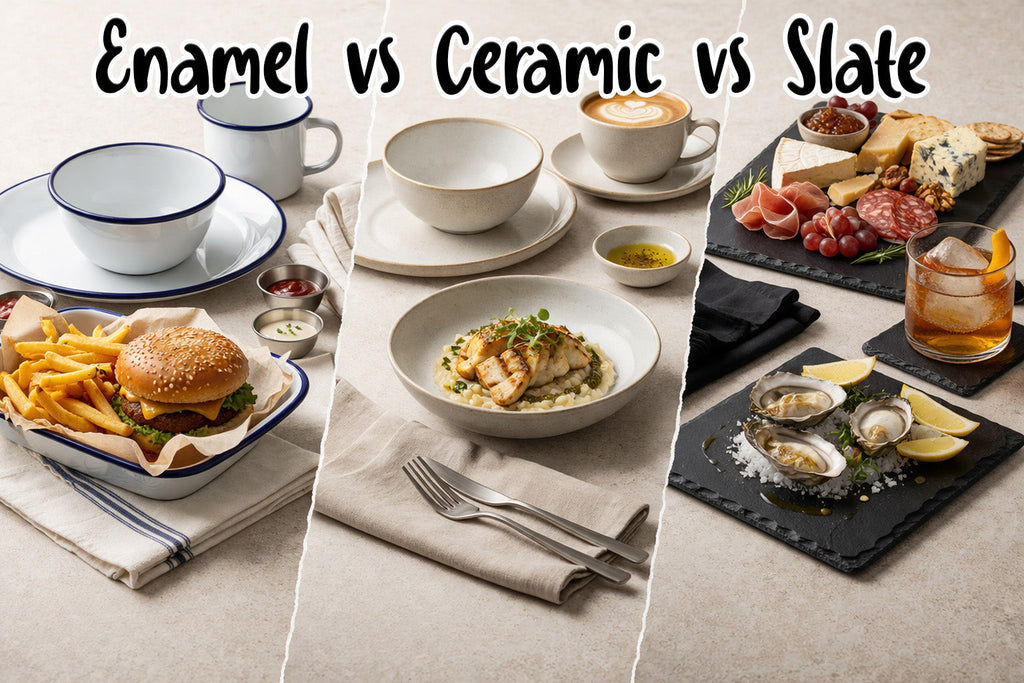
The aesthetic: Heritage. Tactile. Distinctive. Enamelware sits naturally in spaces that feel considered rather than corporate — independent cafés, farm-to-table restaurants, festival venues, countryside gift shops, boutique hotels with a character. The dark rim, the slight weight, the matte finish — these details signal quality without shouting about it.
The practical case: Enamelware is exceptionally durable, dishwasher safe, lightweight relative to ceramic, and works equally well indoors and outdoors. In a commercial kitchen it handles daily service without degrading. On a terrace or market stall it looks just as good as it does in a formal dining room.
The branding opportunity: This is where enamelware genuinely excels. A clean logo, a short phrase, a brand colour applied to the base coat — enamelware takes customisation beautifully and photographs in a way that ceramic simply doesn't. Every piece that leaves your kitchen or your shop floor is a branded asset that keeps working long after the sale.
The limitation: It chips under sharp impact — that's the nature of the material, not a quality failure. It also conducts heat and is not microwave safe, which is worth communicating clearly in a retail context.
Enamelware is right for your brand if: You want tableware that feels distinctive, photographs well, works across indoor and outdoor settings, and carries your branding with confidence. Independent hospitality businesses, cafés with a strong aesthetic identity, gift shops targeting the premium end of the market, and any brand that wants to stand out in a feed full of white ceramic plates.
Ceramic — for brands that want to disappear into the background (in the best way)
Ceramic is the default — and defaults become defaults for good reasons. It's versatile, widely understood, and carries no aesthetic baggage. A well-chosen ceramic piece doesn't impose a mood; it lets the food, the setting and the experience do the talking.
The aesthetic: Clean. Neutral. Adaptable. Ceramic can be matte or glossy, rustic or refined, minimal or expressive. It doesn't arrive with a personality attached — which is either a strength or a weakness depending on what you need it to do.
The practical case: Good quality ceramic is dishwasher safe, microwave safe and chip resistant under normal commercial use. It's heavier than enamelware, which some venues prefer — it feels substantial in the hand and on the table. It's also the most widely available material, which makes sourcing, replacing and scaling straightforward.
The branding opportunity: Ceramic can absolutely be branded — printed, embossed or hand-stamped with a logo or mark. The results tend to be more subtle than enamelware. A small embossed logo on the base of a ceramic bowl reads as considered and premium. A full-surface print on ceramic can look flat compared to the same treatment on enamel.
The limitation: In a world where every table looks like every other table, ceramic is the hardest material to make memorable. It requires stronger design decisions — an unusual shape, a distinctive glaze, a bold colour — to stand out. Plain white ceramic with a small logo is not a brand statement; it's a placeholder.
Ceramic is right for your brand if: Your food and setting are already doing the heavy lifting and you want tableware that supports rather than competes. Fine dining, minimalist concepts, and venues where the aesthetic is deliberately restrained. Also the right call if microwave safety or wide sourcing availability is a practical priority.
Slate — for brands that want to elevate the moment
Slate is not tableware in the traditional sense — it's a serving surface, a presentation choice, a statement. And when it's used well, it does something neither enamelware nor ceramic can: it makes a dish look like it was plated by someone who cares deeply about the detail.
The aesthetic: Artisan. Natural. Grounded. Slate brings the outdoors in — it references stone, craft, provenance. It works beautifully in gastropubs, farm shops, cheeseboards, sharing plates, afternoon teas and anywhere that a sense of occasion matters. It also works in gift retail, where a slate plaque or coaster sits in a completely different category to a standard mug or plate.
The practical case: Slate is heavy, which is a feature as much as a limitation — it anchors a table and gives a sense of permanence to whatever sits on it. It's easy to clean, naturally non-porous, and holds up well in service. It's not suitable for high-heat dishes straight from the oven, and it requires a little more care in storage than ceramic or enamelware.
The branding opportunity: Engraving. This is where slate separates itself entirely from the other two. A laser-engraved logo, name or phrase cut directly into the surface of a slate board is permanent, tactile, and impossible to ignore. Customers run their fingers over it. They photograph it. They remember it. No printed sticker, no stamped ceramic base, no painted logo achieves quite the same effect as a name cut into stone.
The limitation: Slate is a supporting player, not a full tableware solution. You cannot build an entire table setting around it — it works alongside enamelware or ceramic, not instead of them. It's also better suited to specific menu moments — sharing plates, cheeseboards, dessert presentations — than to everyday service.
Slate is right for your brand if: You want to elevate specific moments in your customer's experience — the shared starter, the cheeseboard, the gift that gets kept rather than discarded. Gastropubs, farm shops, deli counters, afternoon tea venues, and gift retailers who want a product with genuine shelf appeal and longevity.
So which should you choose?
The honest answer for most businesses: more than one.
The strongest branded table settings we see combine materials deliberately. Enamelware mugs and plates for the main experience — durable, photogenic, consistently branded. Slate boards for the moments that deserve elevation — the sharing plates, the cheeseboards, the special occasions. Ceramic where practicality demands it — microwave-safe pieces, high-heat dishes, settings where a neutral base is genuinely the right call.
Think of it less as a choice between three options and more as a toolkit. Each material does something the others don't. The brands that look most considered are usually the ones that have thought about which tool belongs where — rather than defaulting to one material across the board because it was easiest.
A few questions to help you decide
- Does your venue have an outdoor element? Enamelware.
- Is your food the visual centrepiece and everything else should support it quietly? Ceramic.
- Do you serve sharing plates, cheeseboards or anything presented rather than just plated? Slate.
- Do you want tableware that photographs well and works as organic social content? Enamelware.
- Are you stocking a gift shop and want products with genuine retail appeal and longevity? All three — at different price points.
- Do you want a premium branded gift that gets kept rather than thrown away? Slate, engraved.
How we can help
At NorthestAve we supply custom branded enamelware, ceramic and slate products to restaurants, cafés, gift shops, event venues and hospitality businesses across the UK and internationally.
Whatever material you decide on — or whatever combination — we can produce it branded with your logo, artwork or copy. And because we have no minimum order quantity, you can test one material before committing, order a mixed run across all three, or start with a single piece and scale from there.
What we offer:
- Custom printed enamel mugs, plates and bowls
- Branded and engraved slate boards, coasters and serving pieces
- No MOQ — order one piece or one thousand
- UK-based with fast turnaround and international shipping
- Trade accounts available for wholesale buyers
Ready to get started?
👉 Browse and customise products directly → (order online with our customisation tool)
For wholesale quotes, bulk orders or just a conversation about what you need:
📞 +44 7356 091993 — call, WhatsApp or SMS, 24/7 📧 sales@northestave.co.uk
No minimum orders. No waiting around. Just drop us a message and we'll get back to you.