The Psychology of Why People Photograph Their Food — And What It Means for Your Brand
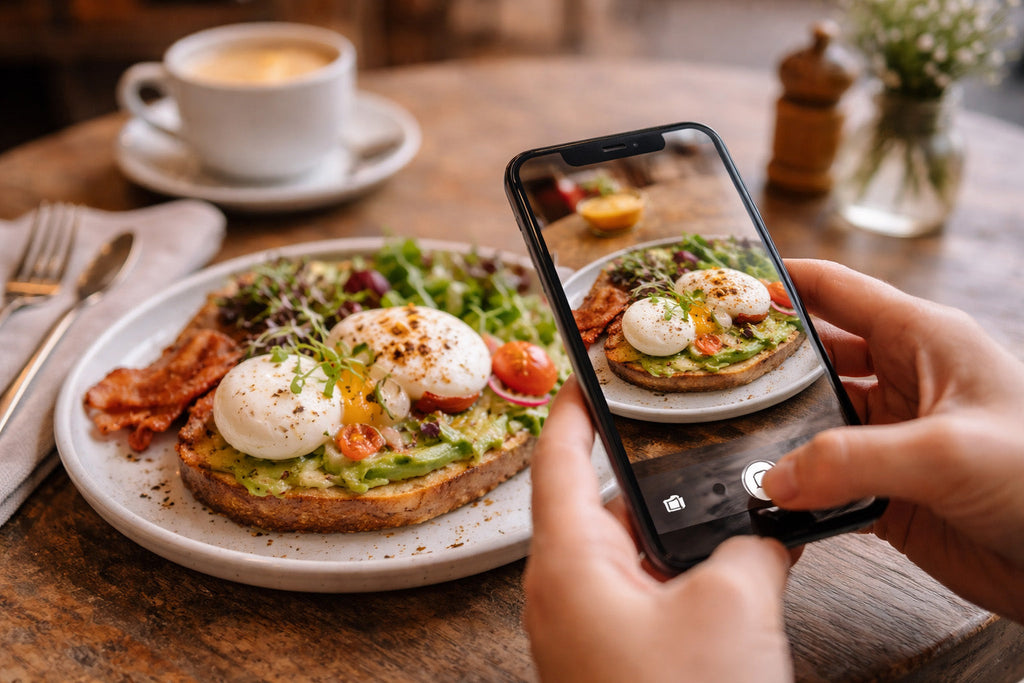
Every day, approximately 1.8 billion photographs are taken worldwide. A significant and growing proportion of them are of food.
Not landscapes. Not portraits. Food.
Specifically — and this is the part worth paying attention to if you run a restaurant, café or hospitality business — food in a specific setting, on a specific surface, in a specific vessel, at a specific moment. The photograph is never really about the food. It's about the experience the food is part of. And the brands that understand this are quietly turning their customers into the most effective marketing operation they've ever had — for free.
Here's the psychology behind why people photograph their food, why the objects around the food matter as much as the food itself, and what it means for the physical decisions you make about your tableware, your presentation and your branded products.
Why people photograph food — what the research actually shows
The impulse to photograph food is not vanity, or not only vanity. Research into the psychology of food photography consistently points to several deeper motivations that are worth understanding if you're in the business of creating food experiences.
Savouring and anticipation. Studies in consumer psychology suggest that photographing food before eating it heightens the sensory experience of eating — the act of documenting something signals to the brain that it's worth paying attention to. A customer who photographs their dish before eating it is, in a measurable sense, enjoying it more than one who doesn't. They are also, by extension, more likely to review it positively afterwards.
Identity signalling. The food people photograph and share publicly is not a random sample of everything they eat. It's a carefully curated signal about who they are, what they value and where they spend their time. A customer who posts your café's branded enamel mug on their Instagram is not just sharing a photo — they're telling their followers something about their own taste and identity. That's a powerful motivation that goes well beyond simply liking a cup.
Memory-making. Photographs are how people preserve experiences. A customer who photographs their meal at your restaurant is creating a memory anchor — something they'll return to when they scroll back through their camera roll, that will remind them of the experience and potentially prompt them to return or recommend it.
Social currency. In a social media environment built around the sharing of experiences, an interesting food photograph is a form of currency — something that generates engagement, comments and connection. Customers are, consciously or not, always evaluating whether a moment is worth sharing. The hospitality brands that consistently produce shareable moments are the ones whose tables photograph well, whose branded objects are visually distinctive, and whose overall aesthetic rewards the camera.
Why the objects matter as much as the food
Here's the insight that changes how you think about tableware: in a food photograph, the food is rarely the only subject.
Look at the most-engaged food content on Instagram and you'll notice a consistent pattern. The photograph almost always features the vessel the food or drink came in, the surface it's presented on, and often a hand, a sleeve, a table edge or a background element that places it in context. The food is the hero — but the objects around it are the supporting cast, and the supporting cast determines whether the overall image is worth sharing.
A flat white in a branded olive enamel mug, held against the wooden table of a characterful independent café, is a photograph that tells a story. The same flat white in an anonymous white ceramic cup tells no story at all. The coffee is identical. The photograph is not.
This is why the decision about what your coffee goes into is a marketing decision as much as an operational one. The mug is in the frame. It is either working for your brand or it isn't.
The elements that make food content shareable
Understanding why people photograph food leads naturally to understanding what makes those photographs worth sharing — and therefore what you can do to increase the likelihood that your food, in your space, gets documented and distributed.
Distinctiveness. The photographs that get shared are the ones that look different to everything else in a feed. A branded enamel mug looks different to a ceramic one. A dish presented on a slate board looks different to the same dish on a white plate. Distinctive objects in a photograph are the reason someone pauses their scroll — and pausing the scroll is the first step to sharing.
Authenticity. The social media environment has become extraordinarily good at identifying content that feels staged versus content that feels real. A customer photograph of a branded mug on a café table, taken in natural light with no styling, performs better than a professional product shot in almost every context — because it looks like a real moment in a real place. Your branded products, in the hands of real customers, in your real space, are the most authentic content your brand will ever produce.
Completeness. The photographs that perform best tend to have a sense of completeness — they tell a story in a single frame. A mug, a book, a patch of sunlight on a café table. A slate board of food at a festival, held in two hands. A breakfast tray in a hotel room with a view through the window. These compositions feel whole — and the branded objects within them are what connects the image back to the place that created it.
What this means for your tableware decisions
The psychology of food photography has a practical implication that most hospitality businesses haven't fully acted on: your tableware is a content strategy.
Every time you decide what your coffee goes into, what your food arrives on, or what your customer is holding when they sit at your table, you're making a decision about whether your brand will appear in the photographs your customers take. An unbranded white ceramic mug will not appear in those photographs as anything attributable to you. A branded enamel mug will — every time, automatically, without you asking.
The hospitality businesses that have the strongest organic social presence in 2026 are not necessarily the ones running the best social media accounts. They're the ones whose physical spaces and branded objects photograph so well, and so distinctively, that their customers do the work for them.
That starts with the mug. It's the most photographed object in any café or restaurant. It's in frame every time. It's in the customer's hand for the duration of the experience. And it either carries your brand or it doesn't.
How we can help
At NorthestAve we supply custom branded enamelware and slate products to cafés, restaurants, hospitality businesses and food vendors across the UK and internationally — with no minimum order quantity.
If you want to start turning your tables into a content strategy, the most practical first step is a branded enamel mug. Order a small run, see how your customers respond, and watch what happens to your tagged content.
Ready to get started?
👉 Browse and customise products directly →
📞 +44 7356 091993 — call, WhatsApp or SMS, 24/7 📧 sales@northestave.co.uk