Custom Branded Mugs With No Minimum Order — What to Know Before You Buy
There's a moment every café owner, restaurant manager and small business has at some point.
You find a supplier. The mugs look perfect. The branding options are exactly what you imagined. You go to the order page — and there it is. Minimum order: 250 units. Sometimes 500. Occasionally, almost insultingly, 1,000.
You close the tab.
It happens thousands of times a day across the UK. Small businesses, new openings, independent venues with a real brand and a real vision — all of them quietly turned away by a minimum order quantity that was designed for someone ten times their size. So they make do with unbranded mugs. Or they over-commit to stock they can't shift. Or they just never get around to it.
Here's what most of those businesses don't know: the minimum order requirement isn't an industry standard. It's a supplier choice. And there are suppliers — including us — who have made a different one.
This guide covers everything you need to know before ordering custom branded mugs with no minimum order — what to look for, what to avoid, what questions to ask, and how to make sure the first mug that arrives with your name on it is exactly what you imagined.
Why no minimum order matters more than most buyers realise
The obvious benefit is the one everyone thinks of first: you don't have to commit to more stock than you need. But the deeper benefit is less obvious and considerably more valuable.
You can test before you scale.
The single most common mistake in branded merchandise is ordering at volume before you've seen the product in your actual space, under your actual lighting, in the hands of your actual customers. A mug that looks perfect in a product photo can look wrong in your café. A colour you were certain about can read differently in reality. A logo that looked great on screen can feel too large, too small, or slightly off-centre when it's printed on a physical object.
With no minimum order, none of that is a costly problem. You order a small run — or a single piece — see exactly how it looks and feels, get it in front of real customers, and make a properly informed decision about scaling up. That process protects your budget and almost always produces a better end result than ordering 500 units and hoping for the best.
It opens up options that didn't exist before.
Seasonal designs. Event-specific mugs. A limited run for a collaboration. A special edition for your fifth anniversary. A different design for your Christmas menu. None of these are realistic propositions when every order requires a 250-unit commitment. All of them become straightforward when there's no minimum to meet.
The businesses with the most dynamic, interesting branded product ranges aren't necessarily the biggest ones. They're the ones with the flexibility to try things, react quickly, and keep their offer feeling fresh.
Enamel vs ceramic — which is right for a no-minimum-order custom mug?
This is the first decision most buyers face, and it's worth getting right before you go any further.
Ceramic is the default — and it's the default for good reasons. It's widely understood, microwave safe, available in a huge range of shapes and sizes, and works in almost any setting. If you need mugs that will go in a microwave, or you want something that sits very neutrally within your existing tableware, ceramic is likely the right call.
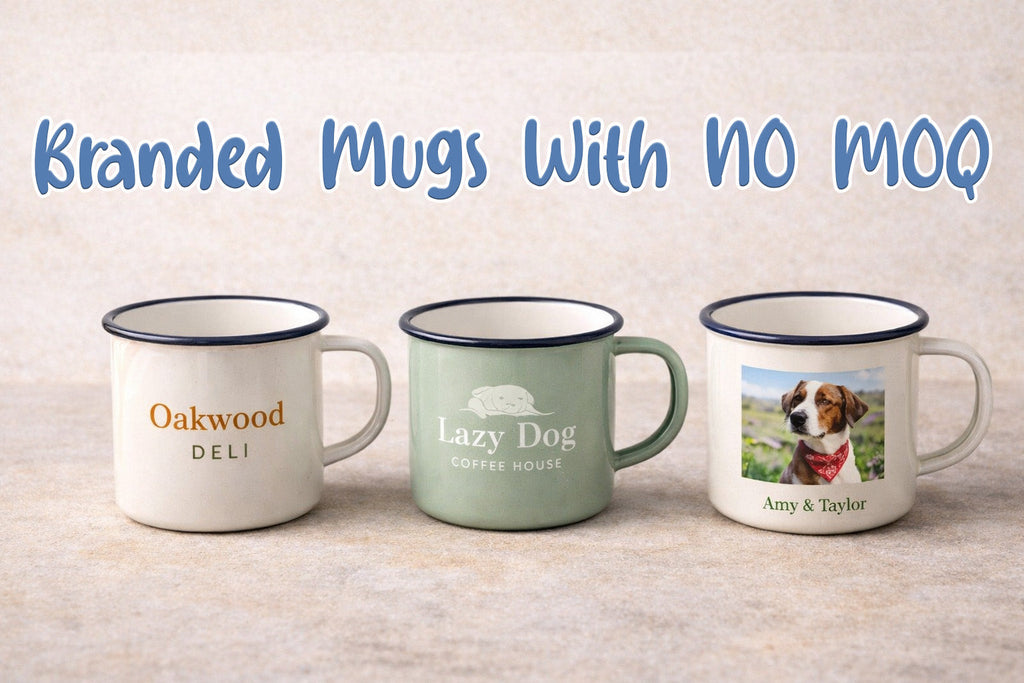
Enamelware is the more distinctive choice — and for a growing number of hospitality businesses, cafés, gift retailers and outdoor vendors, it's the better one. The material — steel coated with a fired glass finish — produces a mug that looks and feels completely different to ceramic. The dark rim. The slight weight. The matte surface that photographs beautifully in natural light. Enamelware doesn't just carry your brand — it communicates something about your brand before the logo is even read.
For businesses where the aesthetic of the mug matters as much as the function — and for any setting where the mug will be photographed regularly — enamelware produces considerably stronger results than ceramic. It also holds up better in commercial use, handles outdoor settings that ceramic can't, and sits in a visual category that's immediately recognisable and distinctive.
The one genuine limitation: enamelware is not microwave safe and will chip under sharp impact. For most café, restaurant and hospitality uses this is irrelevant. For gift retail, it's worth communicating clearly on packaging.
What to look for in a no-minimum-order custom mug supplier
Not all no-minimum-order suppliers are equal — and the ones who offer no MOQ sometimes make compromises elsewhere to offset the flexibility. Here's what to check before you commit.
Print quality and durability
The most important question you can ask any custom mug supplier is how the branding is applied and how it holds up in commercial use. A logo printed with a low-quality process will fade, crack or peel after repeated dishwasher cycles — which is worse than no branding at all, because a peeling logo communicates neglect rather than quality.
Ask specifically: is the print dishwasher safe? How many wash cycles has it been tested to? What printing process is used? A good supplier will answer these questions clearly and confidently. A supplier who hedges or redirects is telling you something.
Artwork requirements
Before you place any order, understand what artwork format the supplier requires. The vast majority of quality suppliers will need a vector file — an AI, EPS or high-resolution PDF — rather than a PNG or JPEG. If you only have a low-resolution logo saved from your website, you'll need to either recreate it in vector format or have a designer do it for you before you order.
Some suppliers offer an artwork checking service as part of the order process. This is worth looking for — it catches problems before production rather than after, which saves both time and the cost of a reprint.
Turnaround time
No minimum order is only useful if the turnaround time is realistic for your needs. Ask specifically: what is the production time from artwork approval to dispatch? For event-driven orders — a festival, a new opening, a seasonal launch — this question matters enormously. A supplier who can turn around a small run in five to seven working days is considerably more useful than one whose lead time is four weeks regardless of quantity.
Samples
Even with no minimum order, some buyers want to see a physical sample before committing to a branded run. Ask whether the supplier offers samples, whether they're charged for, and whether the sample represents the actual production quality rather than a showroom piece. The answer will tell you a lot about how the supplier operates.
Common mistakes to avoid when ordering custom branded mugs
Sending a low-resolution logo. This is the single most common cause of disappointing results. Your logo needs to be a clean vector file. If you're not sure what that means, ask your supplier before you upload anything.
Choosing a colour without seeing it in context. Colours read differently on screen than they do on a physical object under real lighting. If you're ordering enamelware, request a colour swatch or sample before committing to a base coat colour you've only seen on a monitor.
Over-branding the mug. The instinct when you first put your brand on a physical product is to make the logo as large and prominent as possible. Resist it. The mugs that look most considered and premium tend to have smaller, more confident brand marks — not because the brand is hiding, but because restraint signals quality. A logo that fills the entire face of a mug looks like it's trying too hard. A clean mark in the right position looks like it belongs there.
Not thinking about the photograph. Before you finalise your design, ask yourself: how will this look in a photo? Specifically, how will it look in the photos your customers will take — in natural light, on a café table, at a festival, on a kitchen shelf? The mugs that generate the most organic social content are the ones designed with the camera in mind, not just the customer's hand.
Ordering too many colours. Every additional colour in a logo design adds complexity and cost to a print run. For a first order especially, a single-colour logo on a contrasting base coat almost always produces the cleanest, most professional result — and it scales more easily if you want to order seasonal variations later.
How to place your first order — a simple process
If you've never ordered custom branded mugs before, the process is more straightforward than most people expect.
Step one: finalise your artwork. Get your logo in vector format. If you don't have one, a freelance designer can usually produce a clean vector version of an existing logo for a modest fee.
Step two: choose your product. Decide on the mug style, size and base colour. If you're ordering enamelware, think about whether you want the classic white base with a dark rim, or a coloured base coat that aligns with your brand palette.
Step three: decide on your branding placement. Most mugs have a standard placement — centred on the face of the mug, a set distance from the rim. If you have a specific placement in mind, communicate it clearly with your supplier.
Step four: review a proof before approving production. Any reputable supplier will provide a digital proof showing exactly how your branding will appear on the product before going to print. Take time with this step. Check the size, the placement, the colour accuracy. This is your last opportunity to catch anything before it goes into production.
Step five: start small, then scale. Your first order doesn't need to be your biggest. Order what you need to test the product in your setting, see how your customers respond, and make a fully informed decision about your next run.
How we can help
At NorthestAve we supply custom branded enamel mugs and a full range of enamelware to cafés, restaurants, hospitality businesses, gift shops and outdoor vendors across the UK and internationally.
There is no minimum order. You can order a single custom branded mug directly from our website using our online customisation tool — or get in touch if you'd like to discuss a wholesale order, a bespoke brief, or just want advice on what's right for your brand before you commit to anything.
What we offer:
- Custom printed enamel mugs, plates and bowls
- Engraved and branded slate products
- No MOQ — order one piece or one thousand
- UK-based with fast turnaround and international shipping
- Trade accounts available for wholesale buyers
Ready to get started?
👉 Browse and customise products directly → (order online with our customisation tool)
For wholesale quotes, bulk orders or just a conversation:
📞 +44 7356 091993 — call, WhatsApp or SMS, 24/7 📧 sales@northestave.co.uk
No minimum orders. No waiting around. Just drop us a message and we'll get back to you.